
At Forcrete, we partner with developers, architects and specifiers on multi-unit residential projects where finish, performance and lifecycle cost matter. In shared environments, such as build-to-rent dwellings, student accommodation, co-living schemes, or apartment complexes, the choice of surface material must meet many requirements.
It must deliver durability under heavy use, meet building compliance and sustainability standards, be easy to maintain, and support a consistent aesthetic across units and communal zones.
Microcement is emerging as a game-changer in these settings. With the right system, it provides a seamless, high-end finish with performance, waterproofing, low emissions and long service life.
In this article, we explain why microcement makes sense for multi-residential developments, how Forcrete systems meet the key criteria, and what specifiers need to consider in specification, installation and maintenance.
Why microcement suits multi-residential projects
In multi-residential buildings, the shared areas, such as corridors, lobbies, communal kitchens, gyms, and washrooms, and the individual units themselves must withstand heavy footfall, frequent cleaning, varied usage, and tight handover schedules.
Traditional finishes like large-format tiles, vinyl planks or resin coatings often require joints, replacement or grout cleaning, and may cause downtime during refurbishment.
Microcement offers several distinct advantages:
- Seamless transitions, with no visible joints or grout lines across floors and walls, reduce cleaning time and enhance the finish.
- Substrate flexibility, as it can be installed over existing surfaces, is subject to correct preparation, reducing downtime.
- High-performance finish: Forcrete systems combine mineral and polymer resins to create a dense, durable surface. See our systems page for complete details.
- Design continuity, with the same finish applied in individual units, bathrooms, communal stairs and corridors to create a cohesive aesthetic.


Durability and performance in high-traffic communal areas
Shared zones in multi-residential developments require surfaces that remain visually high-quality and functionally sound for many years. With Forcrete microcement:
- After curing, the surface becomes a stable mineral-polymer composite that resists impact, abrasion and movement.
- Because the system is waterproof before sealing, moisture ingress and associated damage in communal wet zones such as showers and washrooms are minimised.
- Maintenance is simplified, with no grout lines to clean, fewer joints to inspect, and surfaces that can be cleaned with pH-neutral or non-harsh maintenance products.
This leads to longer refurbishment cycles, lower lifecycle cost and improved occupant satisfaction, which are key metrics for developers and asset managers.
Compliance and building standards in multi-residential building design
Specifiers working on multi-residential projects must meet several compliance criteria. Forcrete microcement systems are designed to help align with these requirements.
Fire and safety
Multi-unit residential buildings are subject to fire safety standards. The microcement systems we supply are manufactured to rigorous specifications.
Specifiers should always confirm specific building classification, but our systems are designed to support usage in high-occupancy zones.
Indoor air quality and VOC emissions
We use water-based, low-VOC formulations. In multi-residential interiors, including units, communal areas and corridors, material choices influence indoor air quality. Selecting low-emission finishes supports healthier living spaces and meets stricter standards.
See our blog on eco-friendly microcement for background.
Slip resistance and hygiene
Communal areas such as staircases, lobbies and pool surrounds must be safe underfoot. Our finishes offer textured or satin finishes to meet slip-resistance requirements. Seamless surfaces also reduce dirt traps and make cleaning easier.
Sustainability and embodied carbon
Microcement’s thin application, minimal demolition, and long lifespan align with sustainability goals. This can contribute to BREEAM, LEED or other green building accreditation schemes. Forcrete systems support reduced material waste and lower embodied carbon.
Design flexibility for individual units and communal zones
In large-scale residential developments, design consistency across multiple units and shared spaces is essential. Microcement allows:
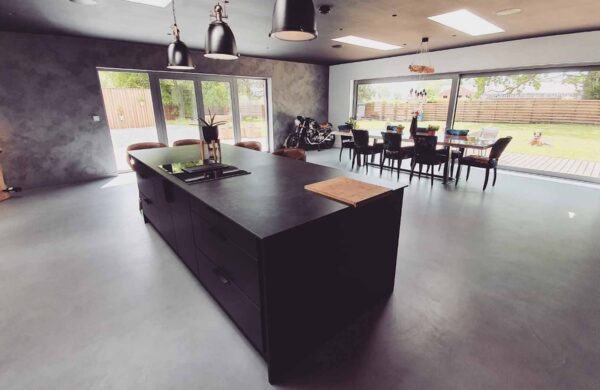
- Uniform colour and finish across floors, walls and joinery for a coherent design language.
- Customisation, with Forcrete offering colour matching and texture variations, including matte, satin, and textured finishes. See our finishes guide for more.
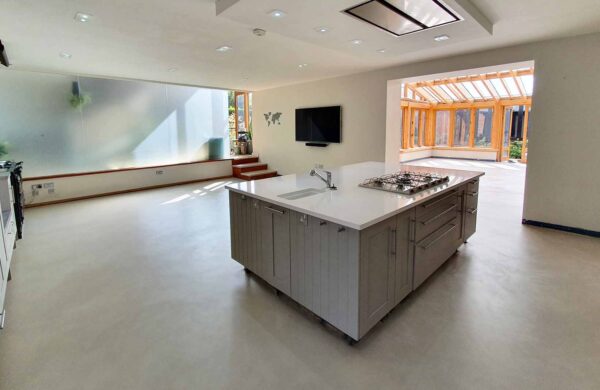
- Seamless transitions between living spaces, bathrooms, kitchens and corridors, which enhances perceived quality and reduces visual breaks.
Using a single system rather than multiple finishes simplifies procurement and reduces on-site interface issues.


Specification and installation considerations
For best results in multi-residential projects, attention to every stage is vital: substrate preparation, correct system build-up, installer training and installation quality control.
Key points for specifiers and contractors:
- Use only approved installers. Forcrete maintains a network of trained professionals via our Find an installer page.
- Ensure the specification matches the environment, for example, high-traffic floors versus wet rooms. See our product system details for our floor system build-up.
- Provide detailed method statements and project-specific documentation, including curing times, ventilation and application environment.
- Ensure proper ventilation and curing in communal spaces, particularly wet zones, to ensure optimal long-term performance.
- Define maintenance schedules and use compatible maintenance products to ensure the finish’s longevity.
Frequently asked questions
Is microcement suitable for large-scale residential developments?
Yes. When specified and installed correctly, microcement is highly suitable for multi-residential projects, offering consistent finishes, durability and performance across units and communal zones.
Does microcement meet fire, indoor air quality and safety standards?
Forcrete microcement systems are designed to support fire-safety classifications, low-VOC emissions and high durability. Always confirm specific product documentation and installer certification.
Can microcement be used for both private units and shared communal spaces?
Yes. The same system can be applied in individual apartments and communal areas, enabling visual consistency and functional performance.
How does microcement deliver waterproofing in high-use wet areas?
Forcrete’s system is fully waterproof before sealers are applied. That makes it ideal for bathrooms, showers and communal wet rooms. Reference our microcement bathrooms page for more.
What maintenance and lifecycle benefits does microcement offer in multi-residential buildings?
Microcement surfaces require less frequent refurbishment, fewer joints to maintain and allow easier cleaning regimes. That translates to lower lifecycle costs and fewer disruptions to occupants.
Conclusion
For multi-residential developments, specifying the right surface finishes affects aesthetics, performance, maintenance and occupant experience. Microcement, when executed correctly, delivers durability, waterproofing, low emissions, design flexibility and lifecycle value.
At Forcrete, we combine world-class systems, trained installers and comprehensive support to ensure your project succeeds. If you are specifying finishes for a multi-unit building and want to ensure compliance, design excellence and durability, contact our specification team or explore our systems in more detail on the Forcrete systems page.