
Restaurants put flooring and wall finishes under constant pressure. Heavy footfall, moving furniture, spillages, cleaning chemicals, and long trading hours all combine to create one of the most demanding interior environments in construction.
Most surface systems fail in hospitality for predictable reasons. Grout lines stain, vinyl wears unevenly, resin floors lose visual warmth, and natural stone requires ongoing maintenance, disrupting operations.
Microcement has become a serious alternative in this space because it addresses many of these weak points when specified and installed as a complete system rather than a decorative coating.
At Forcrete, we see this material used most successfully when designers treat it as a commercial surface system rather than a finish layer.
Why microcement works in restaurant environments
Microcement behaves differently from traditional finishes because it creates a continuous, bonded surface across the substrate rather than sitting as a separate tile or panel system.
This matters in restaurants because movement and cleaning stress usually concentrate at junction points. Grout lines, trims and joints are the first failure zones in most hospitality floors.
A correctly installed microcement system removes these weak points entirely.
However, performance depends on three factors:
- Substrate stability
- Correct system build-up
- Installer competence.
If any of these are ignored, even the best material will fail under commercial load.
Find a Forcrete-approved installer near you today to discuss your microcement installation.
What is microcement in a commercial context?
Microcement is a polymer-modified cementitious coating applied in multiple thin layers over prepared substrates such as screed, concrete, tile or cement board.
In commercial hospitality specifications, it should always be viewed as a multi-layer system, not a single product.
A professional system typically includes:
- Primer layer for adhesion control
- Base coat for structural build
- Reinforcement mesh in movement-prone areas
- Pigmented microcement finish layers
- High-performance sealing system.
Each layer plays a role in how the surface behaves under load.
In restaurant environments, the sealing stage is especially important because exposure includes oils, acidic liquids, alcohol, cleaning chemicals and constant abrasion from furniture.
Why architects and designers specify microcement for restaurants
The specification shift is not purely aesthetic. It is driven by operational efficiency.
Restaurants increasingly need interiors that:
- Reduce maintenance downtime
- Simplify cleaning regimes
- Maintain visual consistency over time
- Support brand identity through material continuity.
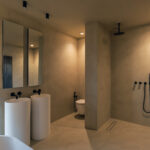
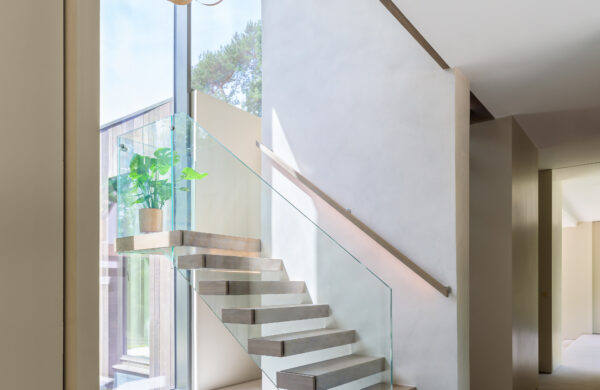
Microcement allows designers to carry a single material across floors, walls, bars and washrooms without visual interruption.
This creates spatial consistency, which is increasingly important in modern hospitality branding.
Microcement vs tiles in restaurant environments
This comparison is often simplified, but in commercial terms, the differences are structural.
Hygiene and cleaning performance
Tiles introduce grout lines that become maintenance points over time. Even with sealing, grout remains more porous than the surrounding tile surface.
Microcement removes grout entirely, reducing contamination zones and simplifying daily cleaning routines.
Movement and impact resistance
Tile systems rely on individual bonded units. When movement occurs in the substrate, failures usually appear at joints.
Microcement bonds as a continuous layer, which distributes stress more evenly across the surface.
Design continuity
Tiles create segmentation by default. Microcement creates an uninterrupted flow, which is particularly effective in open-plan dining spaces.
Lifecycle maintenance
Tiles require partial replacement when failures occur. Microcement can often be resurfaced or recoated, depending on system specification, reducing long-term disruption.
How microcement supports restaurant refurbishments
One of the strongest commercial advantages of microcement is its ability to reduce disruption during refurbishment.
Installation over existing surfaces
In many cases, microcement can be installed over existing tiles or concrete once the surface is properly prepared. This reduces demolition work and waste.
Reduced closure time
Hospitality venues operate on tight trading schedules. Minimising downtime directly impacts revenue protection.
Lower material waste
Avoiding full strip-out reduces disposal costs and environmental impact.
This makes microcement particularly relevant for refurbishment-led restaurant upgrades rather than full rebuilds.
Microcement flooring design ideas for restaurants
Microcement is not a single aesthetic. It behaves as a design platform.
Common applications include:
Fine dining restaurants
Neutral, refined tones with low texture variation to support premium positioning.
Casual dining and cafés
Warmer tones that create a softer, more approachable environment.
Bars and nightlife venues
Darker, more saturated finishes that reduce visual wear from heavy use.
Hotel restaurants
Consistent finishes that connect dining spaces with wider interior architecture.
Open-plan hospitality spaces
Continuous flooring that defines space without physical barriers.
Slip resistance and safety in restaurant floors
Slip performance depends entirely on final system specification and seal selection.
In commercial hospitality projects, microcement systems can be configured to meet slip resistance requirements by adjusting:
- Aggregate structure in final coats
- Sealing system finish level
- Surface texture profile.
This is a specification decision, not a material limitation.
Cost considerations for restaurant microcement projects
Cost varies significantly depending on:
- Substrate condition
- Preparation requirements
- Total surface area
- Detailing complexity (bars, stairs, walls)
- System specification level.
In most restaurant projects, microcement falls in the mid- to high-range compared to tile or vinyl systems. Still, the value comes from reduced maintenance cycles and longer design life rather than the initial material cost.
Why installation quality determines performance
Microcement does not behave like a pre-finished product. It is site-applied and system-dependent.
Performance is directly linked to:
- Surface preparation quality
- Environmental conditions during application
- Installer experience
- Curing and sealing process.
In hospitality environments, installation quality is the difference between a surface that lasts and a surface that fails under traffic.
Frequently asked questions
Is microcement suitable for restaurant floors?
Yes, when installed as a commercial-grade system with correct substrate preparation and sealing.
Is microcement slippery in restaurants?
Slip resistance can be controlled through system specification and seal selection. It is not fixed to the material itself.
Can microcement handle heavy foot traffic?
Yes, but only when designed for commercial hospitality loads and installed correctly.
How long does microcement last in restaurants?
Lifespan depends on system quality and maintenance, but well-specified installations can perform for many years in commercial use.
Can microcement be applied over tiles?
Yes, if the existing tile bed is stable and properly prepared to prevent the transfer of movement.
Is microcement waterproof?
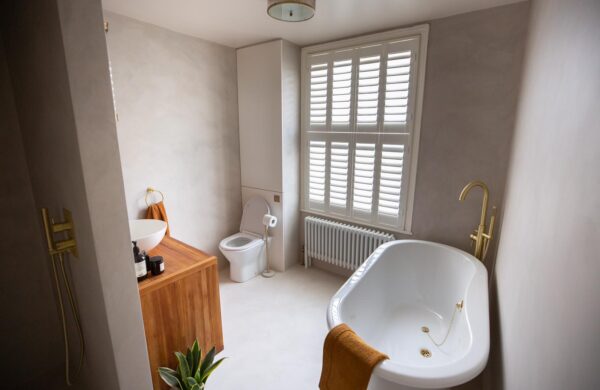
When installed as a full system with appropriate sealing, it can perform as a waterproof surface suitable for washrooms and wet zones.
What are the most common causes of failure?
Movement in the substrate, poor preparation and incorrect system specification are the main causes, not the material itself.
Final thoughts
Microcement has moved beyond a design trend in hospitality environments. It is now a specification-led solution for restaurants that need durability, continuity and design flexibility in equal measure.
Its performance is not defined solely by the material, but by how it is specified, installed, and maintained within a commercial system.
For architects, designers and restaurant operators, the value of microcement lies in its ability to unify aesthetics and performance across demanding environments without relying on segmented surface systems.
When correctly specified, it becomes a long-term architectural finish rather than a short-term decorative layer.
Contact us today to find out more about how we can help you.