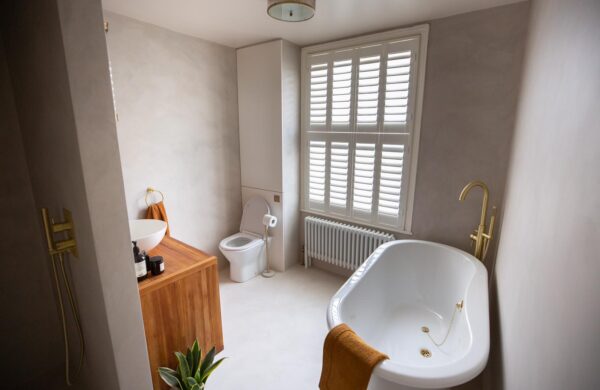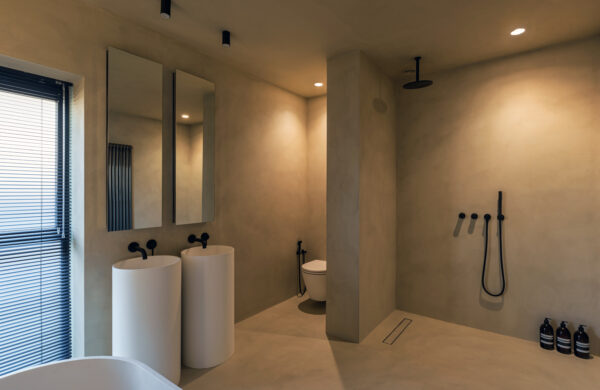
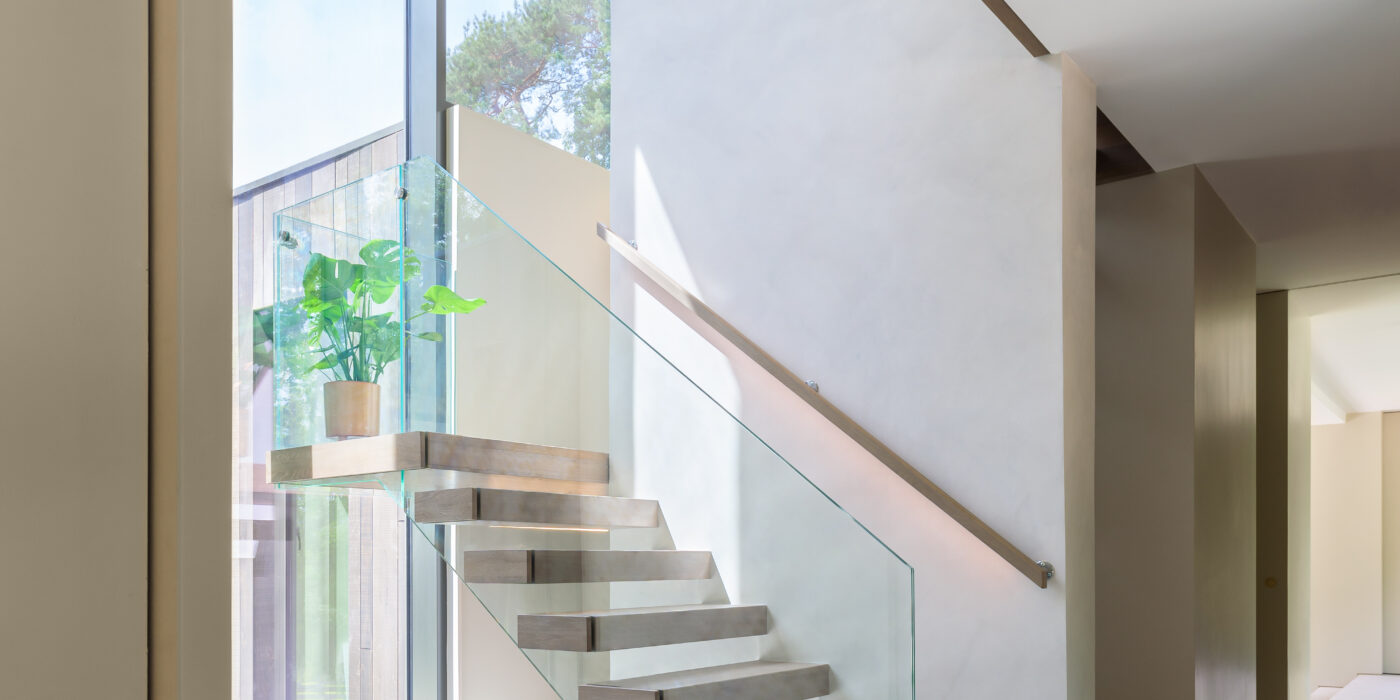
Yes, microcement can be used on stairs, including stair treads and risers where the existing substrate is suitable.
However, a staircase should not be treated simply as a small floor. It contains repeated edges, corners and tread-to-riser junctions, while the surface needs to cope with regular foot traffic. The condition and stability of the existing substrate also need careful consideration.
For that reason, specifying microcement for stairs should begin with the staircase itself, rather than simply choosing a colour.
Why use microcement on stairs?
Microcement allows a staircase to form part of the wider surface design of an interior.
Using the same material across a floor and staircase can create a continuous visual transition between levels. Alternatively, a different colour or finish can give the stairs more definition while retaining the same overall material.
Colour, texture and sheen can all influence the final appearance. Forcrete offers a range of systems and finish options, with different products suited to different applications.
For more information, see our guide to understanding microcement finishes.
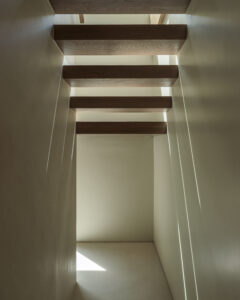
What types of stairs can have microcement applied?
The material used to construct a staircase is important, but its condition and stability are equally significant.
Microcement is applied over a prepared substrate, so the installer needs to assess the existing surface before determining whether it is compatible and how it should be prepared. Forcrete emphasises the importance of thorough substrate preparation and states that its systems can be applied over existing tiles, screeds and boards in appropriate applications.
Concrete stairs
Concrete can provide a suitable substrate for a microcement system when the surface is stable and appropriately prepared.
Forcrete’s TROWEL-X specifications, for example, list concrete among its suitable substrates for the relevant floor system.
Timber stairs
Some Forcrete systems can be installed over certain timber substrates. The TROWEL-X Mesh specification, for example, lists some timber substrates as suitable.
This does not mean every timber staircase is automatically suitable. The condition and construction of the stairs should be assessed by the installer before the system is specified.
Existing tiled stairs
Existing tiles may also be suitable where the substrate is stable and can be properly prepared. Forcrete notes that its systems can, in appropriate applications, be installed over existing tiles and other prepared surfaces.
The important point is that there is no universal preparation method for every staircase. The existing substrate should determine the approach.
Microcement stair treads and risers
Both stair treads and risers can be finished with microcement where the substrate and specified system are appropriate.
The junction between the two deserves particular attention. A staircase contains a repeated series of edges and changes in direction, so application needs to remain consistent across each step.
The same colour and finish can be carried across the treads and risers for a uniform appearance. A change in tone or finish can instead be used to give the individual steps greater definition.
Is microcement suitable for high-traffic stairs?
Stairs can experience significant and concentrated foot traffic, so the system needs to be appropriate for the intended environment.
Forcrete’s TROWEL-X system is described as a highly durable, polished-concrete style finish for high-traffic floors. Its technical documentation also describes the system as suitable for high-traffic floor applications.
However, a system designed for high-traffic flooring should not automatically be assumed to be the correct specification for every staircase. The installer should consider the substrate, environment, expected use and desired finish before selecting the system.
That project-specific approach is particularly important where stairs form part of a commercial or heavily used space.
Are microcement stairs slippery?
Slip resistance should be considered when specifying a microcement staircase, particularly where the environment could introduce moisture or other changes in underfoot conditions.
The final surface characteristics vary according to the selected finish. Forcrete offers different sheen and surface options, so the appearance and practical requirements of the staircase should be considered together.
There is no single finish that should automatically be described as the best option for every staircase. The intended use and environment should guide the specification.
For more information about how texture and sheen affect a finished surface, see our guide to understanding microcement finishes.
Can microcement stairs match a microcement floor?
Yes. Using the same colour and finish across the floor and staircase can create a continuous appearance between levels.
This can work particularly well in open-plan interiors where the staircase is visible from the surrounding living space.
A subtle change in colour or finish can also create definition without introducing another material. The choice depends on whether the staircase is intended to blend into the space or become a more prominent feature.
For more information about microcement flooring, see our microcement flooring guide.
How is microcement applied to stairs?
The installation process depends on the substrate and system, but thorough preparation remains fundamental.
Assess the existing staircase
The installer should establish what the staircase is constructed from and assess the condition and stability of the existing surface.
Prepare the substrate
The substrate needs to be appropriately prepared before the microcement system is applied. Forcrete specifically highlights the importance of high levels of preparation in achieving a quality application.
Apply the system
Forcrete finishes are trowelled on as a continuous surface and built up through multiple layers. The company’s current guidance states that installation generally takes between two and seven days depending on the selected finish.
On a staircase, careful application around tread edges, riser junctions and corners is particularly important to maintain a consistent finish.
Complete the specified finish
The final appearance depends on the selected colour, texture and sheen, as well as the application technique.
The finished staircase should therefore be considered as a complete system rather than simply a decorative coating.
Why professional installation matters
Staircases leave little room for inconsistency. Small variations around an edge or junction can become more noticeable when repeated across a series of steps.
Professional preparation and application are therefore particularly important.
Forcrete has an approved installer network across the UK, Europe and worldwide, and only approved installers can purchase Forcrete products.
You can find a Forcrete approved microcement installer to discuss the existing staircase and the appropriate specification.
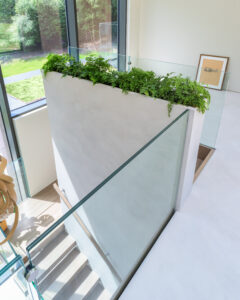
Designing a microcement staircase
The best approach is to consider the staircase alongside the surfaces around it.
Look at the flooring on each level, the available natural light and the materials already present. These factors can help determine whether the staircase should blend into the interior or provide more visual definition.
Colour and finish should also be considered alongside how the stairs will be used. A sample can show how a finish looks, but the complete system and its application need to be considered when assessing performance and suitability.
Forcrete notes that its standard samples do not represent the full system build-up and are not intended for impact or strength testing.
That distinction is important when specifying a staircase. The visual decision and the technical specification need to work together.
Frequently asked questions
Can you use microcement on stairs?
Yes. Microcement can be used on suitable staircases where the existing substrate can be correctly prepared and the selected system is appropriate for the application.
Can you microcement stair treads and risers?
Yes. Both treads and risers can be finished with microcement, subject to the condition of the substrate and the specified system.
Can microcement go over existing stairs?
Potentially. Existing surfaces such as tiles, boards and other substrates can be suitable in the right circumstances, but the condition and stability of the surface need to be assessed first.
Are microcement stairs slippery?
The characteristics of the finished surface depend on the specified finish and the environment. Slip-related considerations should form part of the specification rather than being treated as an afterthought.
Can microcement stairs match a microcement floor?
Yes. The same colour and finish can create a continuous appearance between the floor and staircase, while a different finish can provide greater definition.
How thick is microcement on stairs?
Forcrete states that the total build-up of its system is approximately 3mm, although the exact specification depends on the system and application. Read our guide to how thick microcement is for more detail.
Microcement stairs should be part of the overall specification
Microcement can provide a distinctive finish for a staircase, but the material itself is only one part of the decision.
The existing substrate, preparation, selected system, finish and intended use all need to be considered together. A staircase should be specified as part of the wider flooring and interior design, rather than treated as a separate element at the end of the project.
That approach gives the installer a clear understanding of what the staircase needs to achieve and helps ensure the chosen system is appropriate for the space.
For the right application, microcement can provide a thin, continuous finish that connects different levels while allowing the staircase to sit naturally within the wider interior.