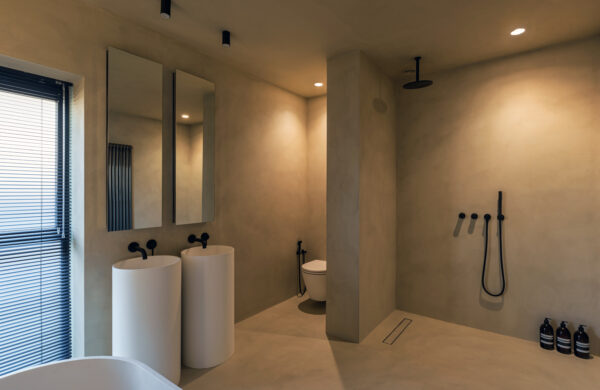
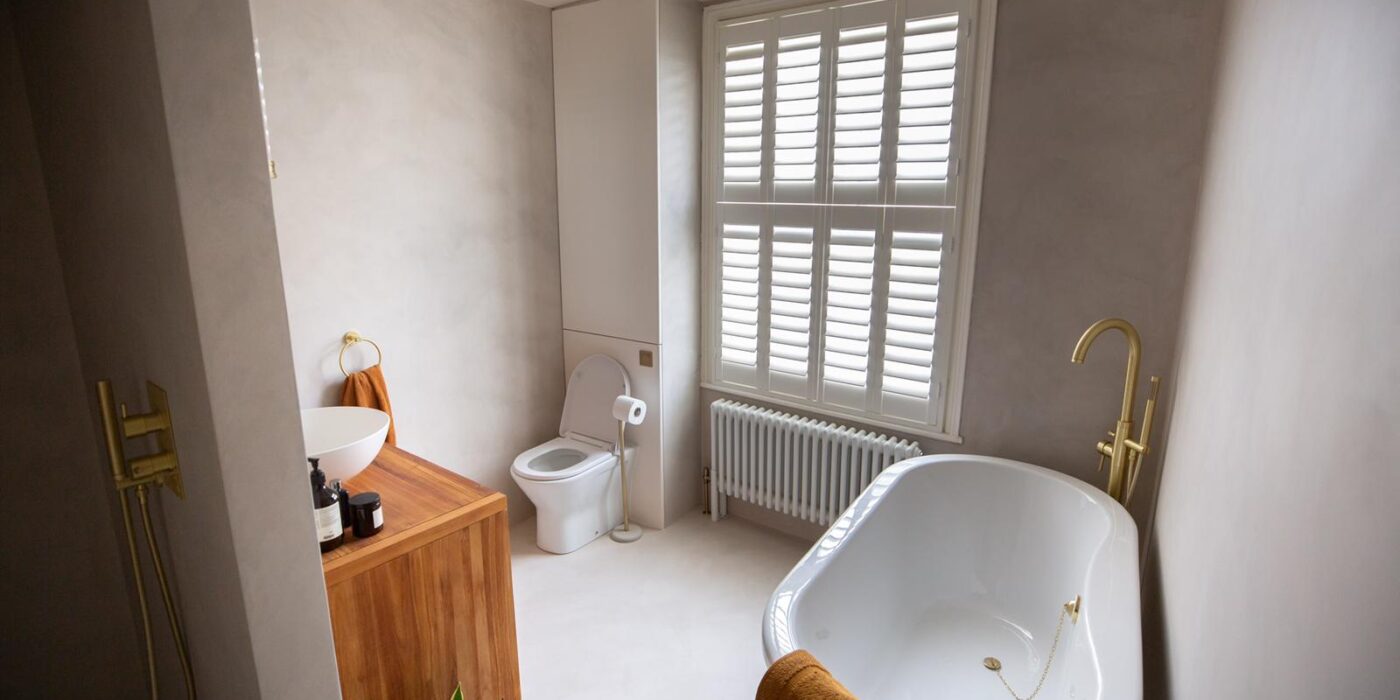
Is microcement slippery? Not inherently. Like other hard flooring surfaces, however, microcement can become more slippery when wet, particularly with a smooth or polished finish.
Slip resistance depends on the finished surface, including its texture and protective coating, as well as where and how it will be used. A finish that works well in a dry living room, for example, may not be the best choice for a shower floor.
This guide explains what affects microcement slip resistance and how to choose the right finish for bathrooms, wet rooms, residential floors and commercial spaces.
At Forcrete, we approach microcement as a complete surface system. The substrate, preparation, base coats, decorative finish and protective system all play a part in how the finished surface performs.
Is microcement slippery when wet?
Microcement can become more slippery when wet, particularly when a very smooth or polished finish has been specified.
This isn’t unique to microcement. Water reduces the grip between bare feet or footwear and smooth hard surfaces, including materials such as polished stone and porcelain.
With microcement, you can choose how the finished surface looks and feels. A smooth finish may work well in a dry interior, while an area regularly exposed to water may benefit from more texture.
Our guide to microcement finishes explains the differences between available finishes and where each may be most appropriate.
So, rather than simply asking whether microcement is slippery, it is worth asking which finish is right for the space.
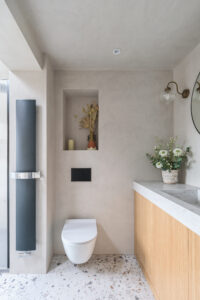
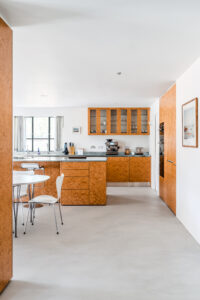

What makes microcement slippery?
Microcement doesn’t have one fixed level of slip resistance.
Surface texture
Texture is particularly important when water is present.
A very smooth surface has fewer surface irregularities than a textured finish, so changing the texture affects both how the microcement looks and how it feels underfoot.
Forcrete’s MICRO-QUARTZ system is available in three finishes:
- Smooth, with no visible grains and a refined appearance
- Medium, with subtle tones and small visible grains
- Coarse, with a more pronounced natural-stone appearance and larger visible grains.
The type of finish
Microcement can also be finished with different levels of sheen.
Polished microcement creates a more reflective, refined appearance.
Matte and satin finishes offer a softer visual effect, while textured finishes introduce more surface variation.
Polished finishes may not be the best choice for every wet floor. Where additional underfoot grip is important, a satin or textured finish may be more suitable.
Water and moisture
A dry living space and a shower floor present very different conditions.
Bathrooms, shower rooms and wet rooms therefore need a microcement system and finish that reflect regular exposure to water.
Forcrete is specifically developed for wet environments and is 100% waterproof before sealers are applied, making it suitable for bathrooms, steam rooms and wet rooms.
There is an important distinction here: waterproofing and slip resistance are not the same thing.
A waterproof microcement system still needs a finished surface suited to how the space will be used.
How the space will be used
Think about what the floor will experience day to day.
Will people walk on it barefoot? How much foot traffic will it receive? Is water or spillage likely? How often will it need cleaning?
A residential hallway, shower floor and busy commercial entrance all place different demands on a surface. These practical details should influence the finish you choose.
Which microcement finish is best for slip resistance?
No one finish is right for every application. Appearance matters, but so do texture, maintenance and how the space will be used.
Smooth microcement
Smooth microcement creates a refined surface with little or no visible grain.
It works particularly well on walls and in dry interiors where underfoot grip isn’t a primary concern. Forcrete’s MICRO-QUARTZ Smooth is a Fino-style finish suitable for applications including bathrooms and lower-traffic floors.
Smooth microcement can therefore be used on floors, provided the finish suits the conditions.
Polished microcement
Polished microcement creates a refined, reflective appearance, but it may not be the best choice for every wet floor.
Satin or textured finishes can be more appropriate where additional underfoot grip is important. A polished bathroom wall, for example, has very different requirements from a shower floor.
Textured microcement
Textured microcement has greater surface variation and works well where a less polished appearance is desired.
Forcrete’s MICRO-QUARTZ Coarse finish has a larger visible grain and is designed for high-traffic walls and floors.
Texture can be part of the design too. A more pronounced finish can add depth and character while retaining the seamless appearance associated with microcement.
Is microcement slippery in bathrooms?
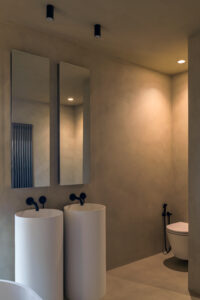
Microcement can be an excellent choice for bathrooms, but not every surface within a bathroom has the same requirements.
Walls, general floor areas, vanity surfaces and shower floors are exposed to different conditions. This means you can maintain a consistent microcement aesthetic while choosing the right specification for each surface.
Forcrete’s microcement bathroom systems can be used across walls, floors, shower areas and other bathroom surfaces.
For floors and other wet areas, you should consider waterproofing and the characteristics of the finished surface.
Is microcement suitable for shower floors?
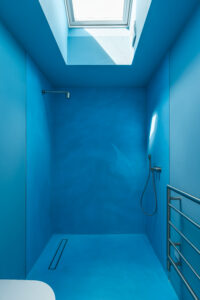
Yes. Microcement can be used on shower floors when the right system, substrate preparation and finish are selected.
A shower floor regularly comes into contact with water and is typically used barefoot, which makes surface finish especially important.
Microcement also has the advantage of being seamless. It can create continuity between the shower floor and walls without the conventional grout lines associated with tiles.
Forcrete is designed for bathrooms, steam rooms and wet rooms and is waterproof before sealers are applied.
We recommend considering the surface texture, drainage and cleaning when specifying a shower floor.
Is microcement suitable for bathroom floors?
Yes. Microcement works particularly well on bathroom floors where a continuous surface without conventional grout joints is desired.
Our microcement flooring can be used across residential and commercial environments and over a range of suitably prepared substrates, including concrete, tiles and wood.
Before choosing a finish for a bathroom floor, consider:
- The existing substrate
- how often the floor will become wet
- the desired level of texture
- the protective finish
- whether it will be used barefoot
- expected foot traffic
- cleaning and maintenance.
These practical factors are far more useful than simply thinking of microcement as either slippery or non-slip.
Can you make microcement less slippery?
Pre-installation is the best time to influence how a microcement floor performs.
If a floor will regularly encounter water, its texture and finish should form part of the initial specification. Depending on the space, a satin or textured finish may suit more than a highly polished surface.
More texture isn’t always better. It changes the appearance and feel of the surface and can affect how easy it is to maintain, so the right level will depend on the application.
Does microcement sealer make it slippery?
Sealer is an important part of a microcement system, but it doesn’t determine the finished surface on its own.
Forcrete’s FORSHIELD-2KWB is a two-component, water-based polyurethane seal coat with a semi-matt finish, and suits environments like bathrooms, worktops, floors and walls.
The final surface characteristics come from the combination of the microcement finish and its protective coating, which is why the two should be considered together.
Is microcement suitable for high-traffic floors?
Yes. Microcement can be used in high-traffic residential and commercial spaces when the flooring system is specified for the demands placed on it.
Forcrete’s MICRO-QUARTZ Coarse finish, for example, is designed for high-traffic walls and floors. More demanding applications can also incorporate reinforcement and other system components, according to the substrate and intended use.
For busy floors, the visible finish is only one part of the installation. The complete system beneath it matters too.
Choosing the right microcement finish
Choosing the right finish comes down to two things: How you want the surface to look and how the space will be used.
Before making a decision, ask:
Where will the microcement be installed?
A living room, bathroom wall, shower floor, kitchen and commercial entrance all have different requirements.
Will the surface regularly become wet?
If water is likely to be present, surface texture and finish become particularly important.
Will people walk barefoot?
This matters most in shower floors, wet rooms and other areas where bare feet and water are likely to combine.
How much traffic will the surface receive?
A busy commercial floor needs to withstand different demands from a lightly used residential space.
What appearance do you want?
Texture affects the look of microcement, influencing its depth, light reflection and overall character.
What does the complete system require?
Primer, base coats, reinforcement where required, decorative coats and protective finishes all contribute to the final surface.
You can explore Forcrete’s microcement systems to understand the options available for different applications.
The importance of correct installation
Microcement is hand-applied, so the quality of the preparation and installation matters.
Assess the substrate before work begins, select the correct system, and apply each layer as intended. For floors and wet areas in particular, getting these fundamentals right is just as important as choosing the final colour or finish.
Forcrete supports professional application through product knowledge, technical support and training. Our approved installer network also gives customers access to experienced installers familiar with our systems.
Planning a project? Find a Forcrete-approved installer to discuss your space.
Frequently asked questions about microcement and slip resistance
Is microcement slippery?
Microcement isn’t inherently slippery, but smooth and polished finishes can become more slippery when wet than more textured surfaces.
Is microcement slippery when wet?
It can be. Water reduces underfoot grip, particularly on smooth or polished surfaces, so the right finish is important in wet areas.
What is the best microcement finish for a bathroom floor?
There isn’t one finish that suits every bathroom. Satin or textured finishes may be more appropriate where floors regularly become wet, particularly in shower areas.
Is microcement suitable for shower floors?
Yes. Microcement can be used on shower floors when the correct system, substrate preparation and finish are specified for the wet, barefoot environment.
Microcement performance starts with the right finish
So, is microcement slippery? Not inherently, but the finish makes a difference.
Smooth or polished surfaces can become more slippery when wet, while satin and textured finishes offer alternatives for areas where greater surface texture is needed.
The right choice ultimately needs to look good and work for the space. That means considering where the microcement will be installed, whether it will get wet, how much traffic it will receive and how the surface will be used.
At Forcrete, that’s where good microcement specification starts. Choose the finish for the space, not just the sample.