
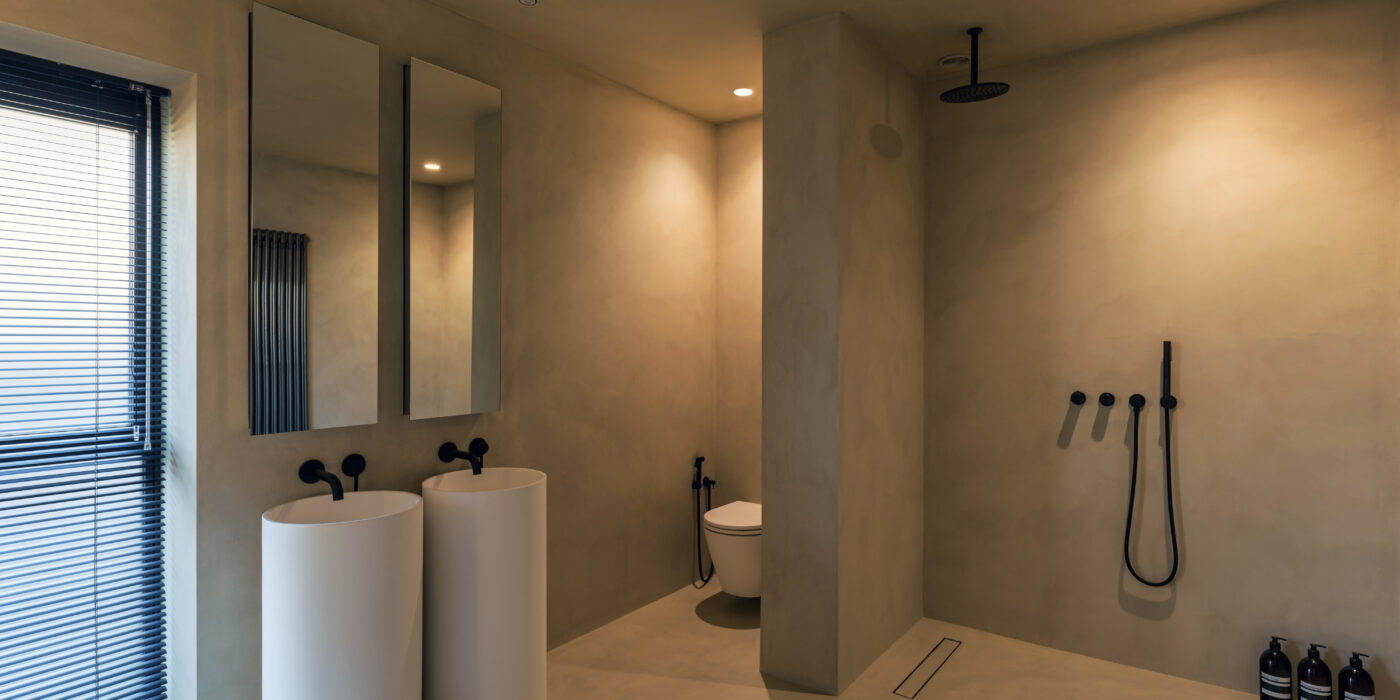
Brighton has always had a layered architectural identity. Regency seafront homes, Victorian terraces, converted industrial spaces and contemporary apartments all sit within a few streets of each other.
That mix creates a consistent design challenge: how to bring coherence to interiors without stripping away character.
In recent years, there has been a noticeable shift in specification choices across the city. Seamless surface systems are now being selected more frequently for both residential refurbishment and commercial fit-outs, particularly where material continuity and long-term durability matter.
Microcement in Brighton has become part of that shift, not as a decorative finish, but as a complete surface system that allows floors, walls and wet areas to behave as one continuous architectural plane.
Why microcement in Brighton performs well in coastal and mixed-age properties
Brighton introduces a combination of conditions that influence material selection more than in many other UK cities. Humidity from the sea, salt exposure in seafront properties, and a broad range of building ages all affect how surfaces behave over time.
Microcement systems respond well in this context because they are built in bonded layers rather than rigid, segmented formats. When correctly installed, they move with the substrate rather than against it, which is particularly important in older Brighton properties where natural movement is unavoidable.
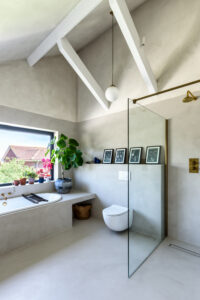
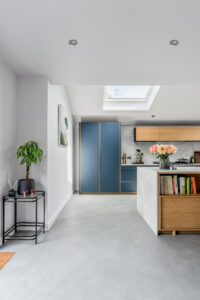
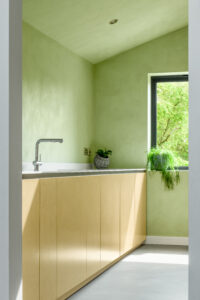
Brighton Victorian and Regency homes
In period properties, the challenge is rarely aesthetic. It is almost always substrate stability.
Floors are often uneven, wall build-ups vary, and previous renovations introduce multiple layers of material. Microcement allows these surfaces to be unified without removing or overbuilding existing structures, which is often a key consideration in conservation-led areas.
Seafront properties and coastal exposure
In seafront apartments and coastal homes, moisture management becomes more critical.
Airborne salt and consistent humidity can accelerate wear in traditional grout-based or jointed systems.
A properly specified microcement system forms a continuous sealed surface that reduces moisture ingress at the surface level, making it well suited to these environments when installed as part of a controlled system build.
Where microcement is being used across Brighton projects
The growing adoption of microcement Brighton-wide is not limited to one typology of project. It is being specified across a wide range of residential and commercial environments.
Microcement bathrooms in Brighton homes
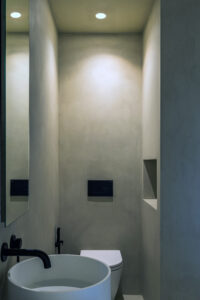
Bathrooms remain one of the most common applications. The removal of grout lines fundamentally changes both the visual and functional behaviour of the space.
Without joints, the surface becomes easier to maintain and less prone to staining or mould development. In compact Brighton bathrooms, this also helps visually expand the space by reducing surface fragmentation.
More details about microcement bathrooms here.
Microcement floors in Brighton interiors
Flooring applications have become increasingly common in Brighton apartments and refurbished homes where open-plan layouts are prioritised.
A continuous microcement floor creates a consistent visual language across kitchen, dining and living areas. This is particularly effective in properties where natural light is a key architectural feature, as uninterrupted surfaces reflect and distribute light more evenly.
Its compatibility with underfloor heating also makes it a practical choice for modern refurbishments. Find out more about microcement flooring here.
Kitchens and living spaces
In kitchen environments, microcement is often specified to reduce visual segmentation between surfaces. Floors, splashbacks and sometimes worktop areas can be treated as part of a continuous material palette.
This creates a more architectural approach to kitchen design, where surfaces are defined by proportion and light rather than material contrast.
Commercial spaces in Brighton
The hospitality and retail sectors in Brighton have also contributed to increased demand. Cafés, boutique hotels, and independent retail spaces are particularly drawn to seamless finishes because they offer durability under foot traffic while maintaining a refined aesthetic.
In these environments, the surface is not just decorative. It becomes part of the spatial experience, particularly under mixed lighting conditions where joints and transitions can become visually distracting.
Brighton microcement and performance in coastal conditions
One of the more practical considerations in Brighton projects is environmental exposure.
Coastal air introduces consistent humidity and airborne salt, which can affect traditional finishes over time. In response, specification increasingly focuses on system performance rather than surface appearance alone.
A correctly installed microcement system provides a sealed, continuous layer that limits surface moisture penetration. However, long-term performance is always dependent on substrate preparation, reinforcement strategy and installation control.
Where issues typically arise is not in the material itself, but in inconsistent installation methods or incorrect substrate assessment.
Why installation quality matters more in Brighton projects
Microcement behaves as a system rather than a standalone finish. That distinction becomes more important in Brighton, where property conditions vary significantly from one project to the next.
Key factors that influence performance include:
- Substrate movement and stability
- Correct priming and preparation
- Reinforcement placement in high-risk areas
- Environmental conditions during curing
- Installer familiarity with system behaviour.
In older Brighton properties especially, small variations in substrate condition can significantly influence long-term results if not properly addressed at the specification stage.
This is why controlled installation through experienced applicators is essential for system consistency.
We work with a number of Forcrete-approved installers in the Brighton area. Find the installer for you today.


What defines a Forcrete microcement system in Brighton applications
Forcrete systems are developed for professional installation environments where performance consistency matters as much as aesthetics.
Key system characteristics include:
- Fully waterproof system built before sealing
- Epoxy resin hybrid formulation for structural strength
- Compatibility across floors, walls and wet areas
- Low VOC composition suitable for interior environments
- Controlled installation through approved applicators.
Rather than functioning as a decorative coating, the system is designed as a complete architectural surface solution.
Design direction and material choices in Brighton interiors
Brighton interiors tend to respond strongly to natural light and coastal atmosphere. This influences material and colour selection in a subtle but consistent way.
Microcement finishes in Brighton projects are often selected in:
- Warm neutral greys
- Softened concrete tones
- Sand-inspired natural shades
- Muted off-whites.
These tones allow interiors to sit comfortably within changing daylight conditions, particularly in coastal locations where light shifts throughout the day.
The absence of joints also allows colour to read more consistently across large surfaces, reinforcing spatial continuity.
Cost considerations for Microcement in Brighton
Cost in microcement projects is rarely defined solely by the material. In Brighton, several factors tend to influence overall project scope:
- Condition and complexity of existing substrates
- Extent of surface preparation required
- Number of wet zones within the project
- Detailing complexity around edges, stairs and transitions
- Overall system specification and finish level.
In period properties, preparation often becomes the most significant variable due to substrate inconsistency. This is particularly relevant in Brighton’s Victorian and Regency housing stock.
Microcement Brighton FAQs
Is microcement suitable for Brighton coastal properties?
Yes, when installed as a complete system, it performs well in humid and coastal environments, including seafront homes.
Can microcement be installed over existing tiles?
In many cases, it can, provided the existing surface is stable and correctly prepared as part of the system build-up.
Does microcement crack over time?
Cracking is typically linked to substrate movement or inconsistent installation rather than to the material itself.
Is microcement waterproof in bathrooms?
When installed as a full system, it forms a waterproof surface suitable for bathrooms and wet rooms.
How long does installation take in Brighton homes?
Timelines vary depending on substrate condition and curing requirements, but most residential projects are completed in staged application phases.
Is microcement suitable for commercial spaces in Brighton?
Yes, it is widely used across hospitality and retail environments due to its durability and seamless finish.
Closing perspective: Why Brighton continues to adopt microcement systems
The increasing use of microcement in Brighton reflects a wider shift in how interior surfaces are being considered.
Rather than focusing on isolated finishes, designers and homeowners are now prioritising systems that deliver continuity, durability and long-term performance across mixed environments.
Brighton, with its combination of coastal exposure and architectural variety, is particularly well suited to this approach.
Microcement continues to grow here not because it is a trend-driven material, but because it consistently solves a very specific set of design and performance challenges, both architecturally and in practice.